
What is My Age Today? The One Question That Can Make Or Break Your Government Job Application
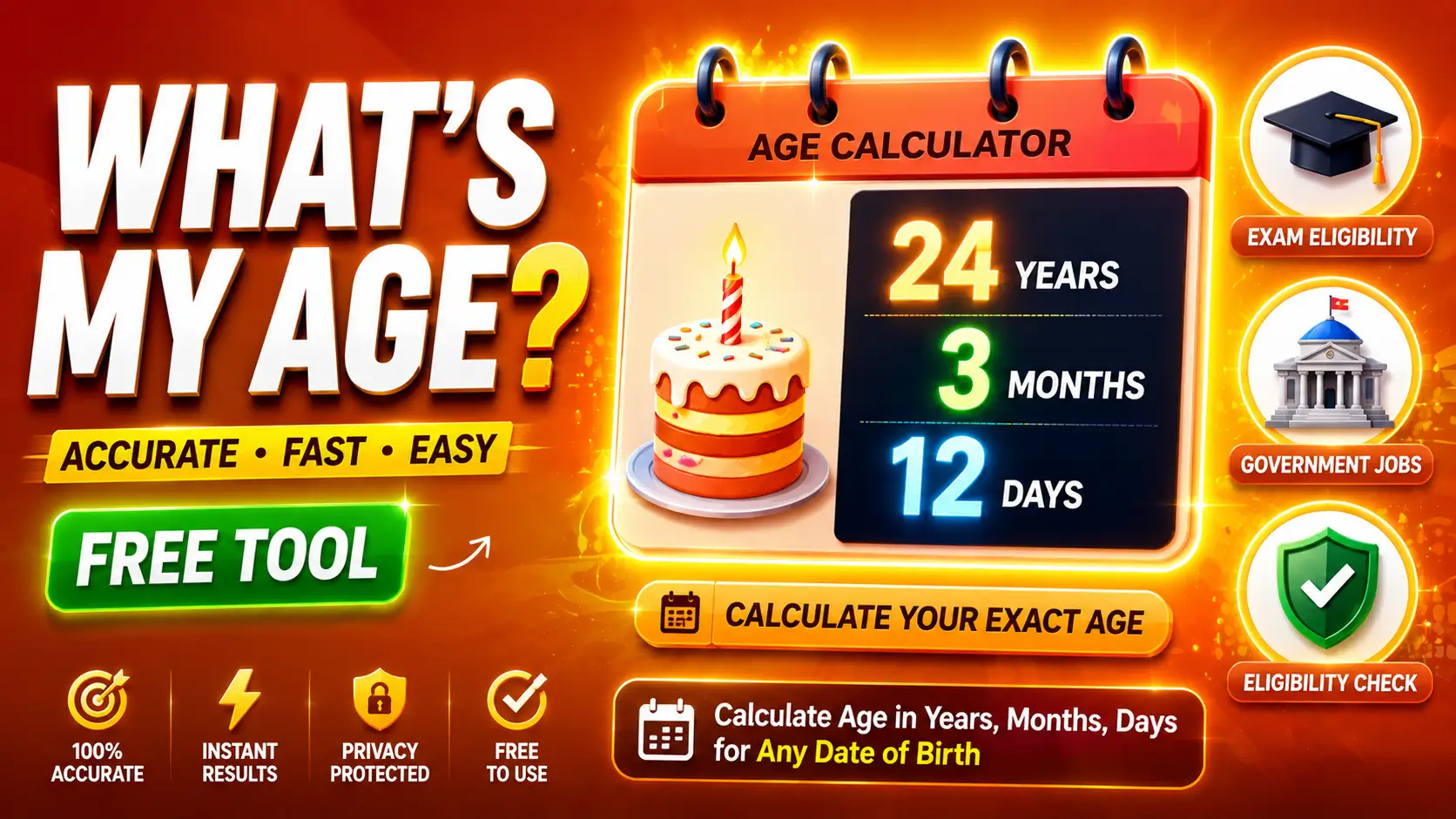
Most people think they know how old they are. But do you know your exact age – years, months and days – as at a certain date? Getting that answer wrong by even a day can mean your application for a government job gets shot down out of hand.
Every year lakhs of students preparing for UPSC, SSC, Railway and Banking exams miscalculate their age against the official cutoff date. Some find this out too late, after they’ve submitted the form. They would have saved with a simple age checker tool.
What "What is My Age" Actually Means
When people type "what is my age" online, they usually want one of three things:
- Their current age in years (“I am 24 years old”)
- Their age in years, months and days, as of the official use
- Their age on a given past or future date (e.g. for eligibility)
A basic birthday calculation gives you #1. But for govt exams, scholarships, school admissions & retirement calculations you need #2 & #3. That’s where a proper date age calculator comes in handy.
Who Uses an Age Calculator the Most?
Age Calculator India is used by people in India but one bunch of people that clearly stands out are the government job aspirants.
The competitive entrance exams are the most important use case of an age calculator in India. UPSC, SSC, IBPS, RRB, and State PSCs conduct various exams every year in which millions of aspirants appear. Almost all official notification includes some clause about age limits – and borderline candidates, especially those whose birthdays fall just a few days before or after the cut-off, are at risk of a manual miscalculation that could lead them to believe they are eligible when they are not, or vice versa.
Besides exam aspirants, the other people who use an age calculator regularly are:
- Parents checking whether their child is of sufficient age for admission to Class 1 school
- HR managers computing employee service period or checking retirement dates
- Doctors keeping track of patient age in weeks or months for infant care
- Visa and passport applicants age verification for documentation.
- Senior citizens pension eligibility dates and PF checking dates
The Cut-Off Date Rule – How a Single Day Can Change Everything
Most people don’t know the most important thing about government exam age limit:
Crucial Rule
Your eligibility is determined by your exact age on a specific cut-off date, not the date you complete the application form. For example, if the notification says ‘Age as on 01.08.2026’, you have to calculate your exact age on that particular date.
This means if your birthday is August 2nd and the cut-off is August 1st - then you are one day too young and not eligible. No exceptions.
Here are the standard cut-off dates used by major Indian exam bodies:
| Exam Body | Common Cut-Off Date |
|---|---|
| UPSC Civil Services | 1st August of exam year |
| SSC CGL / CHSL | 1st January of exam year |
| Railway NTPC / Group D | 1st January of exam year |
| IBPS Banking Exams | Varies by notification |
| State PSCs | Varies by state |
One day over the age limit disqualifies a candidate. The government exams follow the “as on” concept – your age is calculated as on a particular cut-off date and not on the date of application or the date of the exam.
How to Use the Free Age Calculator by ToolCompanion
- Visit ToolCompanion.com and launch the Age Calculator tool
- Enter your Date of Birth (day, month and year)
- The tool will instantly tell you how old you are in years, months and days as of today
- To change the “Calculate Age As On” date to your exam notification's official cutoff date for exam eligibility
- Find your exact age in seconds on that particular date
No need to register. Not ads. Just a clean, accurate result you can count on.
Age Limits for Top Government Exams in India (2025-26)
| Exam | Min Age | Max Age (Gen) | Age Relaxation |
|---|---|---|---|
| UPSC Civil Services | 21 years | 32 years | OBC +3 yrs, SC/ST +5 yrs |
| SSC CGL | 18 years | 27-30 years | OBC +3 yrs, SC/ST +5 yrs |
| SSC CHSL | 18 years | 27 years | OBC +3 yrs, SC/ST +5 yrs |
5 Real Life Situations Where an Age Calculator is Useful
- Scenario 1 - The Borderline UPSC Aspirant: Priya Date of birth: 15 August 1995 Is she eligible for UPSC Civil Services Examination 2026? The last date of UPSC CSE is 1st August of the year of examination. She puts in her DOB and the cut off date into the age calculator, and immediately knows if she has any attempts left.
- Scenario 2 - School Admission for a Child: Parents can check if their children are eligible for school admissions under the Right to Education Act.
- Scenario 3 – Retirement of Government Employee: A central government employee can verify his superannuation date by calculating his exact age as on month end.
- Situation 4 - Scholarship Age Limit: Many national and state scholarships have an age limit of 25 or 30 years. A date calculator check takes 5 seconds.
- Situation 5 - Passport and Visa Documentation: For some visa categories, the applicant must be under a certain age on the date of application.
How Is Age Calculated? (The Simple Explanation)
If someone is born on 15th August 1995, and today is 10th June 2025, the calculator first finds complete years (29 years till August 2024), then counts months from August 2024 to June 2025 (9 complete months), and finally counts remaining days from May 15 to June 10 (26 days). This gives the answer as 29 years, 9 months & 26 days. This is exactly how age is calculated in the Indian Government for UPSC, SSC and banking recruitments.
Frequently Asked Questions
What's my age if I was born on a leap day (29th February)?
For non-leap years, most systems will consider your birthday to be either February 28 or March 1. Check the specific recruitment notification for government exam purposes, some of them say this directly. The age checker ToolCompanion correctly manages leap year calculations.
Can I calculate my age on a future date?
Yes. Enter your date of birth and set the target date to any date in the future, the calculator will tell you your exact age on that date. This is very useful to check upcoming exam cut off dates.
Is age relaxation added automatically?
ToolCompanion’s age calculator shows, as it really is your age. For category wise relaxation like OBC, SC/ST, PwBD, please see the official notification and manually deduct the relaxation years from the upper age limit.
How is age for school admission calculated in India?
Most states require children to be at least 5 or 6 years old by June 1st or March 31st of the year of admission. Enter the tool with your child’s date of birth and the admission cut-off date as the target date.
Does the calculator work for international age calculation?
Yes. The tool works for any date of birth and any target date regardless of country. Age is the same all over the world .
Calculate your exact age now
Find your exact age in years, months, and days with our free, zero-latency age calculator.

Author
Kartik Pachare
Kartik Pachare is the founder, developer, and SEO expert behind ToolCompanion. With experience in web development, search engine optimization, and Performance Marketing, his mission is to build free, private, and genuinely helpful tools that make the web simpler for everyone. When he's not coding, Kartik is analyzing web data and exploring the next generation of online utilities.
Connect with Kartik on LinkedInComments (0)
No comments yet. Be the first to share your thoughts!